

The Importance of Artificial Intelligence in Education
Artificial Intelligence (AI) has moved from being a futuristic concept to becoming a powerful force that is reshaping industries across the world
Haseeb Ali M K
3/3/20262 min read
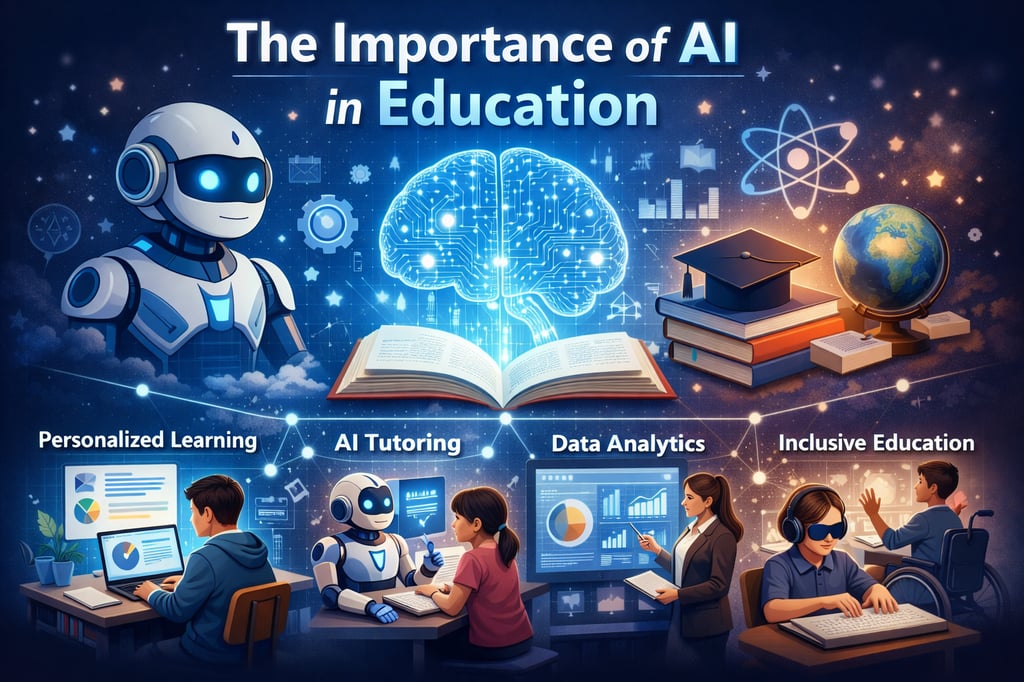
In recent years, Artificial Intelligence (AI) has moved from being a futuristic concept to becoming a powerful force that is reshaping industries across the world. One of the most impactful transformations is happening in the field of education. AI is not just changing how students learn — it is redefining how teachers teach, how institutions operate, and how knowledge is delivered.
1. Personalized Learning for Every Student
Every student learns differently. Some understand concepts quickly, while others need more time and support. Traditional classrooms often follow a “one-size-fits-all” approach. AI changes this completely.
AI-powered learning systems can:
Analyze student performance
Identify strengths and weaknesses
Suggest customized learning paths
Provide additional practice where needed
This creates a personalized learning experience, ensuring no student is left behind and advanced learners are not held back.
2. Intelligent Tutoring Systems
AI-based tutoring systems can act as 24/7 learning assistants. These systems can:
Answer student queries instantly
Provide step-by-step explanations
Offer practice problems
Give real-time feedback
Students no longer need to wait for classroom hours to clear doubts. Learning becomes continuous and flexible.
3. Automation of Administrative Tasks
Teachers spend a significant amount of time on repetitive tasks such as:
Grading assignments
Taking attendance
Preparing reports
Managing schedules
AI tools can automate these tasks, saving time and allowing teachers to focus more on teaching, mentoring, and innovation.
4. Data-Driven Decision Making
AI helps institutions analyze large volumes of data to:
Track student progress
Predict dropout risks
Improve curriculum design
Enhance academic performance
With data-driven insights, institutions can make better strategic decisions and improve overall educational quality.
5. Bridging the Skill Gap
The job market today demands skills in AI, Machine Learning, Data Science, and automation. Integrating AI into education ensures that students are not just consumers of technology but creators of it.
When students are exposed to AI tools:
They develop problem-solving skills
They understand real-world applications
They become industry-ready
They gain a competitive advantage
6. Inclusive and Accessible Education
AI can make education more inclusive through:
Speech-to-text tools
Language translation systems
Assistive technologies for differently-abled students
This ensures that education is accessible to everyone, regardless of physical or geographical limitations.
Conclusion
Artificial Intelligence is not just a trend in education — it is a transformation. It personalizes learning, supports teachers, enhances institutional efficiency, and prepares students for the future.
The institutions that integrate AI thoughtfully today will shape the leaders of tomorrow.
Education powered by AI is not about replacing humans. It is about amplifying human potential.